Seed Quality Infrastructure as an Economic Driver of Agricultural Development
A Perspective from Indonesia
DOI:
https://doi.org/10.62012/dgwddc47Keywords:
Seed Quality Infrastructure, Agricultural Development, Economic Growth, Food Security, Public Investment, Institutional PerformanceAbstract
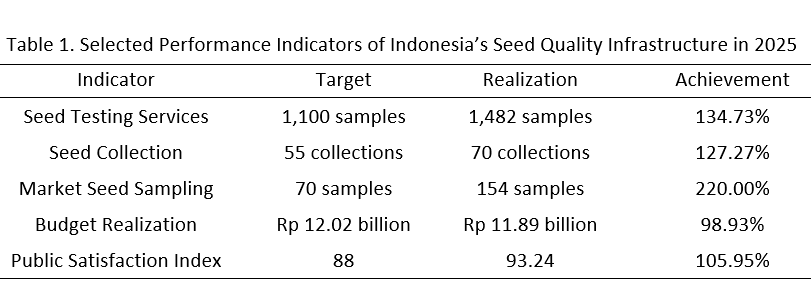
Agricultural development remains a strategic pillar of economic growth, food security, and rural welfare in developing countries. While considerable attention has been directed toward agricultural inputs such as fertilizers, irrigation systems, and mechanization, the economic role of seed quality infrastructure has received comparatively limited attention. This perspective article argues that seed quality assurance institutions represent a critical form of economic infrastructure that supports agricultural productivity, reduces market inefficiencies, and strengthens food security outcomes. Using the 2025 Annual Report of Indonesia’s Center for Seed Testing and Quality Assurance (BBPPMBTPH) as an illustrative case, this paper examines how public investment in seed quality systems contributes to broader agricultural development objectives. The report indicates high institutional performance, with testing services exceeding annual targets by 34.73%, budget realization reaching 98.93%, and user satisfaction categorized as very good. Beyond their technical functions, seed testing laboratories play an economic role by reducing information asymmetry, mitigating production risks, and enhancing confidence in agricultural markets. This perspective highlights the importance of viewing seed quality infrastructure not merely as a regulatory mechanism but as a strategic investment that supports productivity growth, food security, and sustainable agricultural transformation. Strengthening seed quality institutions through digitalization, capacity building, and integrated governance frameworks may therefore generate substantial economic returns for the agricultural sector and national development.
Downloads
References
[1] BBPPMBTPH, Laporan Tahunan 2025. Depok, Indonesia: Balai Besar PPMBTPH, 2026.
[2] FAO, Seed and Seed Quality: Technical Information for FAO Emergency Staff. Rome, Italy: Food and Agriculture Organization, 2010.
[3] FAO, Promoting the Growth and Development of Smallholder Seed Enterprises for Food Security Crops. Rome, Italy: Food and Agriculture Organization, 2010.
[4] N. P. Louwaars and W. S. de Boef, “Integrated seed sector development in Africa: A conceptual framework for creating coherence between practices, programs, and policies,” Journal of Crop Improvement, vol. 26, no. 1, pp. 39–59, 2012.
[5] D. J. Spielman and A. Kennedy, “Towards better metrics and policymaking for seed system development: Insights from Asia’s seed industry,” Agricultural Systems, vol. 147, pp. 111–122, 2016.
[6] OECD, Boosting Productivity and Trade through Seed Certification. Paris, France: OECD Publishing, 2023.
[7] ISTA, International Rules for Seed Testing. Bassersdorf, Switzerland: International Seed Testing Association, 2025.
[8] ISTA, “Seed quality testing and certification,” International Seed Testing Association, 2025.
[9] R. E. Evenson and D. Gollin, “Assessing the impact of the Green Revolution, 1960 to 2000,” Science, vol. 300, no. 5620, pp. 758–762, 2003.
[10] P. L. Pingali, “Green Revolution: Impacts, limits, and the path ahead,” Proceedings of the National Academy of Sciences, vol. 109, no. 31, pp. 12302–12308, 2012.
[11] S. McGuire and L. Sperling, “Seed systems smallholder farmers use,” Food Security, vol. 8, pp. 179–195, 2016.
[12] L. Sperling, S. McGuire, and T. Remington, “Moving towards more effective seed aid,” Journal of Development Studies, vol. 44, no. 4, pp. 586–612, 2008.
[13] W. S. de Boef, T. Subedi, N. Peroni, M. Thijssen, and E. O’Keeffe, Eds., Community Biodiversity Management: Promoting Resilience and the Conservation of Plant Genetic Resources. London, UK: Routledge, 2013.
[14] C. Biemond, N. P. Louwaars, P. C. Struik, and C. J. M. Almekinders, “Understanding seed quality in informal seed systems,” Agronomy for Sustainable Development, vol. 33, pp. 345–354, 2013.
[15] J. D. A. van Etten, “Crowdsourcing crop improvement in sub-Saharan Africa: A proposal for a scalable and inclusive approach to food security,” IDS Bulletin, vol. 42, no. 4, pp. 102–110, 2011.
[16] A. G. A. M. van Gastel, Z. Bishaw, and B. R. Gregg, “Seed quality control,” in Seed Production and Processing. Aleppo, Syria: ICARDA, 2002.
[17] World Bank, World Development Report 2008: Agriculture for Development. Washington, DC: World Bank, 2007.
[18] FAO, IFAD, UNICEF, WFP, and WHO, The State of Food Security and Nutrition in the World 2023. Rome, Italy: FAO, 2023.
[19] Y. Wang, X. Li, and J. Zhang, “Research on multilateral collaboration strategies in seed quality supervision,” Scientific Reports, vol. 14, 2024.
[20] SGS, “Harvesting prosperity: The essential role of seed quality control in agricultural success,” SGS, 2024.