Fiscal Transparency and Public Financial Management as Drivers of Economic Development
A Perspective from Indonesia’s Ministry of Finance Financial Reports
DOI:
https://doi.org/10.62012/nyzaad97Kata Kunci:
Fiscal Transparency, Public Financial Management, Economic Development, Fiscal Governance, Public Accountability, Fiscal SustainabilityAbstrak
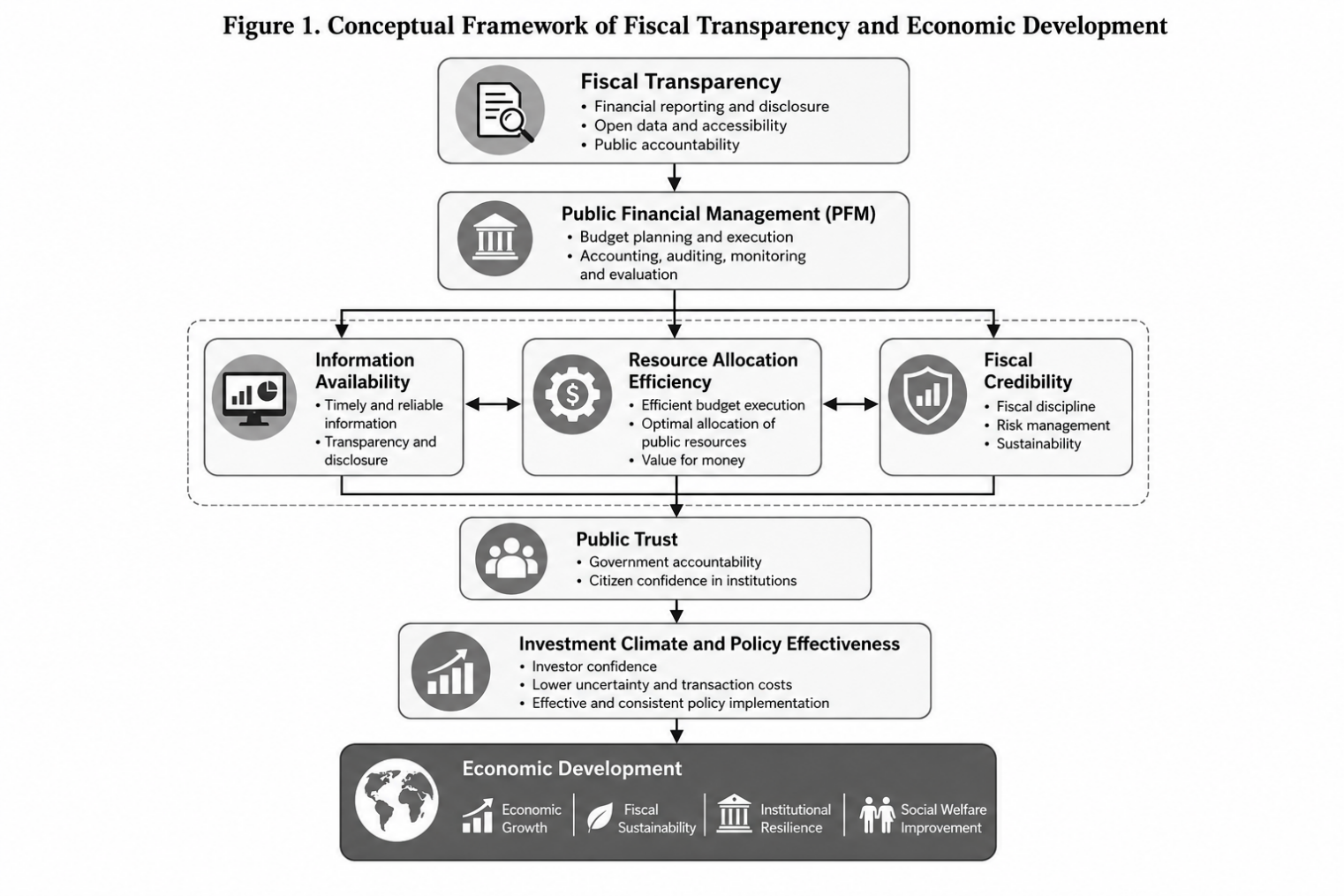
Fiscal transparency and effective public financial management are increasingly recognized as fundamental components of sustainable economic development. While government financial reports are commonly viewed as instruments of accountability and regulatory compliance, their broader contribution to economic governance remains relatively underexplored. This perspective article examines how fiscal transparency and public financial management contribute to economic development through improved information availability, efficient resource allocation, strengthened fiscal credibility, and enhanced public trust. Using the 2023–2024 financial reports of Indonesia’s Ministry of Finance as an illustrative case, the study analyzes selected financial indicators, including budget realization, assets, liabilities, revenues, and institutional financial performance. The findings indicate positive developments in fiscal management, reflected by a 12.57% increase in budget realization, 8.25% growth in total assets, and 20.66% growth in total revenues between 2023 and 2024. These trends suggest strengthening institutional capacity and improved effectiveness in public financial management. Beyond their accounting function, government financial reports serve as governance infrastructure that reduces information asymmetry, supports evidence-based decision-making, and enhances accountability. This article argues that public financial management should be viewed not merely as an administrative process but as a strategic driver of economic development. Strengthening fiscal transparency through digital transformation, integrated financial information systems, and performance-based budgeting can further improve development effectiveness, fiscal sustainability, and long-term economic resilience.
Unduhan
Referensi
[1] Kementerian Keuangan Republik Indonesia, Laporan Keuangan Kementerian Keuangan Tahun Anggaran 2024 Audited. Jakarta, Indonesia: Kementerian Keuangan, 2025.
[2] Kementerian Keuangan Republik Indonesia, Laporan Keuangan Kementerian Keuangan Tahun Anggaran 2023 Audited. Jakarta, Indonesia: Kementerian Keuangan, 2024.
[3] Kementerian Keuangan Republik Indonesia, “Laporan Keuangan Kemenkeu,” 2026.
[4] International Monetary Fund, Fiscal Transparency Code. Washington, DC: IMF, 2019.
[5] International Monetary Fund, Fiscal Transparency Handbook. Washington, DC: IMF, 2018.
[6] International Monetary Fund, Manual on Fiscal Transparency. Washington, DC: IMF, 2007.
[7] PEFA Secretariat, Public Expenditure and Financial Accountability Framework for Assessing Public Financial Management. Washington, DC: PEFA, 2016.
[8] PEFA Secretariat, Guidance on Public Financial Management Performance Measurement Framework. Washington, DC: PEFA, 2020.
[9] World Bank, Public Financial Management and Accountability in an Integrated Fiduciary Assessment. Washington, DC: World Bank, 2010.
[10] World Bank, World Development Report 2017: Governance and the Law. Washington, DC: World Bank, 2017.
[11] World Bank, World Development Report 2022: Finance for an Equitable Recovery. Washington, DC: World Bank, 2022.
[12] OECD, Recommendation of the Council on Budgetary Governance. Paris, France: OECD Publishing, 2015.
[13] OECD, Government at a Glance 2023. Paris, France: OECD Publishing, 2023.
[14] OECD, Public Governance for Trust and Growth. Paris, France: OECD Publishing, 2021.
[15] International Public Sector Accounting Standards Board, Handbook of International Public Sector Accounting Pronouncements. New York, NY: IFAC, 2024.
[16] INTOSAI, The Lima Declaration of Guidelines on Auditing Precepts. Vienna, Austria: International Organization of Supreme Audit Institutions, 1977.
[17] INTOSAI, The Mexico Declaration on SAI Independence. Vienna, Austria: International Organization of Supreme Audit Institutions, 2007.
[18] United Nations, E-Government Survey 2022: The Future of Digital Government. New York, NY: United Nations, 2022.
[19] M. Cangiano, T. Curristine, and M. Lazare, Eds., Public Financial Management and Its Emerging Architecture. Washington, DC: International Monetary Fund, 2013.
[20] A. Schick, “Why most developing countries should not try New Zealand reforms,” The World Bank Research Observer, vol. 13, no. 1, pp. 123–131, 1998.